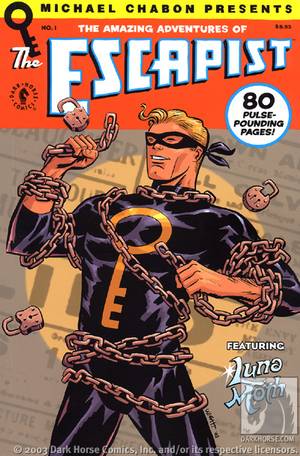
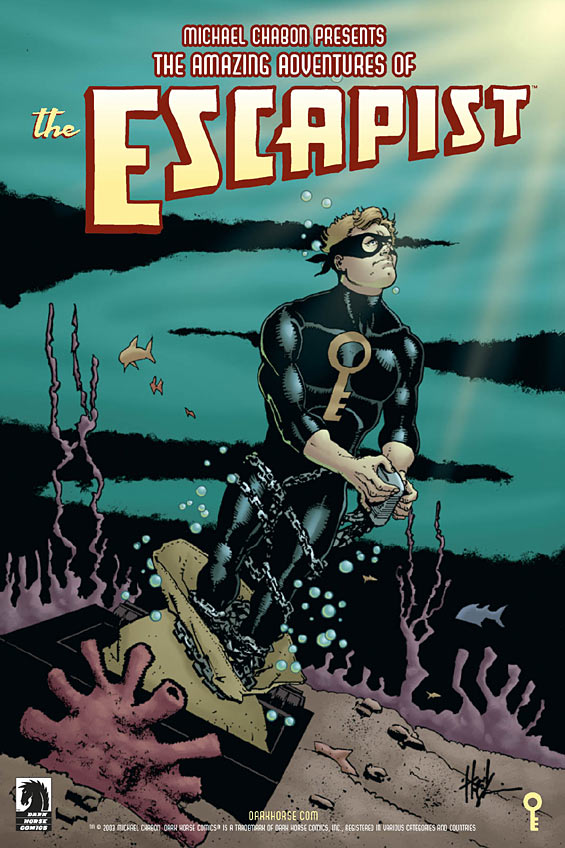
Part of what makes The Amazing Adventures of Kavalier and Clay so interesting is the unusual storytelling progression that the author, Michael Chabon decides to employ. As stated in one of my previous posts, chapter one starts with the outcome of Sam and Joe's hard work. From there Sam is developed, and he and Joe meet. This creates a temporary sense of mystery surrounding Joe, who seems to have a serious, deliberate personality. The book then jumps back to Joe's childhood, and gives a lengthy development of Joe through his childhood. The plot then jumps forward to where Sam and Joe are being meeting with Sam's boss, Anapol. The plot settles down long enough to show the process of Sam and Joe putting together a team of artists, create their first comic book, and bring it in to Anapol, who meets the book with doubt, but decides to give it a shot. The book then jumps forward again to when Sam and Joe's comic becomes extremely successful, and Anapol changed his companies focus from novelty product to backing The Escapist and the other comic book heroes. By taking these seemingly random and large leaps all over the chronological stream of his novel, Chabon creates a realistic depiction of life itself, in the form of a flashback. Sometimes stages in a person's life seem to stretch on for an eternity, and sometimes the weeks fly by and nothing of interest happens. When Chabon does settle on a time period, he stays long enough to fully develop the situation and the resolution, and then right when the plot is about to get stale, he throws a curve ball and jumps to a new problem. It works very well, and creates a sense of unpredictability.
Chabon also makes a relatively unknown art the center of Joe's life: The art of escape. I knew who Houdini was before reading this novel, but I never knew how he did what he did, nor did I have any objection to my naivety on the subject. Chabon presents the process in which Joe learns the toils of an escape artist in a highly gradual and descriptive manner, that makes me feel as if I too am being taught. Chabon writes knowledgeably about the subject, which makes it all the more intriguing and engaging. The relative obscurity of the topic that Chabon decided to develop is a major part of what makes it so interesting, as I have not ever read anything like it.
Tuesday, November 24, 2009

Chapter 1: Reaction and Analysis
The Amazing Adventures of Kavalier and Clay starts off chronologically scrambled, starting with the phrase, "In later years." The very first sentence gives the outcome of Sam and Joe's struggle to become comic book artists, showing them being interviewed at a comic convention. It introduces their superhero, the Escapist, who is said to be based off of Houdini. The results to the situations of the first 200 pages of the book are immediately concluded. Personally, I usually prefer to see a problem build up, and watch as the characters devise a situation, as I slowly discover the course of a novel. However, Michael Chabon manages to make this style work quite well. Though he gives away the plot at the beginning of his novel, he doesn't introduce the characters or the situation until later in the novel. As I read this paragraph, I didn't understand who the characters were or what their goal was, so I proceeded into the book none the wiser. It wasn't until later, that the information began to sink in for me, making the resolution retain their freshness.
Chabon then proceeds to introduce Sam. He explains this character in a lighthearted, humorous, and exaggerated manner, creating a literary caricature. "His face was an inverted triangle, brow large, chin pointed, with pouting lips and a blunt, quarrelsome nose." This single sentence set up the overall mood of the book, which was one of whimsical overtones, even in dire situations. As soon as this introduction ceases, the setting shifts to Sam's home, right as he is introduced to Joe. The two start off with a typical awkward introduction, but soon start to mesh, starting with the moment that they share a cigarette that Joe scavenged from some butts and a small square of paper. Sam is impressed by the accuracy of this improvised cigarette, saying that it looked as if it where made by a machine. When they went back to bed, Sam fell asleep, feeling comforted by the company of a potential partner. The chapter ends on this sentence, foreshadowing the strong bond that was to be created between the cousins. This part of the book moves fast and makes several chronological jumps, which continue throughout the entire novel. The time jumps become less frequent, but more noticeable, as several chapters will be dedicated to Joe's childhood, and then he is suddenly in the office of Sam's boss. Overall, this introduction strayed from status quo, and created an interesting progression. I felt compelled to read on and see these characters further developed. The first chapter succeeded in its task to snare me due to it's abnormal structure, and for that I consider it to be a compelling commencement to the novel.
Chabon then proceeds to introduce Sam. He explains this character in a lighthearted, humorous, and exaggerated manner, creating a literary caricature. "His face was an inverted triangle, brow large, chin pointed, with pouting lips and a blunt, quarrelsome nose." This single sentence set up the overall mood of the book, which was one of whimsical overtones, even in dire situations. As soon as this introduction ceases, the setting shifts to Sam's home, right as he is introduced to Joe. The two start off with a typical awkward introduction, but soon start to mesh, starting with the moment that they share a cigarette that Joe scavenged from some butts and a small square of paper. Sam is impressed by the accuracy of this improvised cigarette, saying that it looked as if it where made by a machine. When they went back to bed, Sam fell asleep, feeling comforted by the company of a potential partner. The chapter ends on this sentence, foreshadowing the strong bond that was to be created between the cousins. This part of the book moves fast and makes several chronological jumps, which continue throughout the entire novel. The time jumps become less frequent, but more noticeable, as several chapters will be dedicated to Joe's childhood, and then he is suddenly in the office of Sam's boss. Overall, this introduction strayed from status quo, and created an interesting progression. I felt compelled to read on and see these characters further developed. The first chapter succeeded in its task to snare me due to it's abnormal structure, and for that I consider it to be a compelling commencement to the novel.
Character Study
The characters in The Amazing Adventures of Kavalier and Clay are the backbone of the plot, as they are developed and interesting. First and foremost are the title characters, Josef (Joe) Kavalier, and Sammy Klayman (Sam Clay). They collaborated to create The Escapist, their successful comic superhero. Both characters are introduced, but in completely different manners. Sam is described and dissected in the second paragraph of the first chapter, setting him up as a somewhat shallow character, establishing that while he was interesting, he would not be the focus of the novel. Personality-wise, Sam is shown to be a typical city boy with small origins and big visions. He is given a dialect that utilizes, but doesn't overuse, his Brooklyn origins. His sentences are riddled with typical city slang, which makes his interactions with his foreign cousin, Joe, mildly humorous.
The author soon dedicates about fifty pages to giving a back story to Josef Kavalier. The setting jumps to the past, where Joe is living a comfortable life with his busy parents, who tend to neglect him in favor of their jobs. From an early age, Joe is shown to have a fascination with Houdini, and the concept of escape artists. He eventually obtains an apprenticeship under Bernard Kornblum, and old, but experienced and accomplished escape artist. The author spends quite a bit of time discussing Joe's gradual improvements in picking locks, maneuvering his way out of ropes, and developing a natural feel for utilizing his tools. By the time World War II struck and the Germans were soon to occupy Czechoslovakia, Joe had become a skilled escape artist. His parents give up all that they own in order to safely send Joe to America, but he is denied passage. Unable to go back an face his family, Joe goes to Kornblum, and they devise a complicated plan that eventually lands him in Sam's house. Compared to Sam's one page back story, Joe's development could be it's own novel. Joe is a complex character, who doesn't say much of his intricate thoughts through his fractured English. Sam wants to write comic books simply to earn money, but Joe uses his illustrations to convey his anger at Nazi Germany, and he hopes to eventually earn enough money to see his family again. Sam's sole purpose as a character seems to be to make Joe's character stand out as complex by the contrast created by his own stark simplicity. Both characters are believable and act within their confines, but Joe seems to ultimately be the focus of the story.
The author soon dedicates about fifty pages to giving a back story to Josef Kavalier. The setting jumps to the past, where Joe is living a comfortable life with his busy parents, who tend to neglect him in favor of their jobs. From an early age, Joe is shown to have a fascination with Houdini, and the concept of escape artists. He eventually obtains an apprenticeship under Bernard Kornblum, and old, but experienced and accomplished escape artist. The author spends quite a bit of time discussing Joe's gradual improvements in picking locks, maneuvering his way out of ropes, and developing a natural feel for utilizing his tools. By the time World War II struck and the Germans were soon to occupy Czechoslovakia, Joe had become a skilled escape artist. His parents give up all that they own in order to safely send Joe to America, but he is denied passage. Unable to go back an face his family, Joe goes to Kornblum, and they devise a complicated plan that eventually lands him in Sam's house. Compared to Sam's one page back story, Joe's development could be it's own novel. Joe is a complex character, who doesn't say much of his intricate thoughts through his fractured English. Sam wants to write comic books simply to earn money, but Joe uses his illustrations to convey his anger at Nazi Germany, and he hopes to eventually earn enough money to see his family again. Sam's sole purpose as a character seems to be to make Joe's character stand out as complex by the contrast created by his own stark simplicity. Both characters are believable and act within their confines, but Joe seems to ultimately be the focus of the story.
Themes from American Literature
The American Dream is often explored in American literature, and when introduced, is often met with hardships and failure. In The Amazing Adventures of Kavalier and Clay, Sam and Joe strive for, and against all odds, achieve, the American Dream. This dream is none other than that of success, although it is often thought incorrectly to be easily obtained. Most characters who grasp this goal aren't aware of the hard work and persistence behind success, thus they fail to reach it. Sam strongly mirrors Willy Loman for the earlier portion of the book. Sam is doing very poorly at his company as an inventory clerk, but he lies to his mother, telling her that he is an artist and that his boss likes him, when the truth is that he is completely dispensable. When his cousin, Joe, arrives, things change.
Joe had just arrived from a long, arduous journey from Czechoslovakia to Brooklyn, narrowly escaping the stranglehold of the war in Europe. Joe had to leave his family behind, who gave up all that they owned in order to get Joseph out of the country. Therefore, Joe was determined to become successful in America, so that he might one day have the chance to see his family again. He spent much of his childhood learning the skills to become an escape artist, which lent him determination from a young age to become accomplished in other fields too, such as illustration. When Joe's dedication and skill met with Sam's ambition and vision, a powerful duo was formed. Sam immediately took Joe to see Anapol, his boss, stating that they could create a new superman. Upon Anapol's approval, Sam goes above and beyond, bringing together a group of artists to draw an entire comic book. Anapol was skeptical at first of the true potential of Sam's comic book, but with Sam's constant pressing and high spirits, he decided to give it a shot. The comic book is successful, and Sam and Joe become triumphant. This backs the age old concept that commitment, hard work and taking advantage of opportunity lead to great things. Sam doesn't give up despite his difficulties, and he finally reaches his dream because of it.
Another strong theme is that sometimes hard work is dismissed as a futile effort. Anybody who has ever worked towards recognition in a competitive field knows the frustration and hopelessness brought forth by being rejected or ignored after trying their best. Today's world is very demanding, and the best of the best is sometimes the only acceptable work. Upon reading their first comic book, Anapol started off with criticism, saying that the book simply wasn't good enough to compete, and that he just didn't get The Escapist, the hero that Sam and Joe put the most effort into. The eventual success of Sam and Joe seems almost unrealistic, given the merciless nature of the entertainment industry. The harsh truth is that hard work and effort must also be backed by talent, and a knowledge of what the public wants.
Joe had just arrived from a long, arduous journey from Czechoslovakia to Brooklyn, narrowly escaping the stranglehold of the war in Europe. Joe had to leave his family behind, who gave up all that they owned in order to get Joseph out of the country. Therefore, Joe was determined to become successful in America, so that he might one day have the chance to see his family again. He spent much of his childhood learning the skills to become an escape artist, which lent him determination from a young age to become accomplished in other fields too, such as illustration. When Joe's dedication and skill met with Sam's ambition and vision, a powerful duo was formed. Sam immediately took Joe to see Anapol, his boss, stating that they could create a new superman. Upon Anapol's approval, Sam goes above and beyond, bringing together a group of artists to draw an entire comic book. Anapol was skeptical at first of the true potential of Sam's comic book, but with Sam's constant pressing and high spirits, he decided to give it a shot. The comic book is successful, and Sam and Joe become triumphant. This backs the age old concept that commitment, hard work and taking advantage of opportunity lead to great things. Sam doesn't give up despite his difficulties, and he finally reaches his dream because of it.
Another strong theme is that sometimes hard work is dismissed as a futile effort. Anybody who has ever worked towards recognition in a competitive field knows the frustration and hopelessness brought forth by being rejected or ignored after trying their best. Today's world is very demanding, and the best of the best is sometimes the only acceptable work. Upon reading their first comic book, Anapol started off with criticism, saying that the book simply wasn't good enough to compete, and that he just didn't get The Escapist, the hero that Sam and Joe put the most effort into. The eventual success of Sam and Joe seems almost unrealistic, given the merciless nature of the entertainment industry. The harsh truth is that hard work and effort must also be backed by talent, and a knowledge of what the public wants.
Golems
In The Amazing Adventures of Kavalier and Clay, Josef Kavalier (Later nicknamed Joe) is trying to escape to the United States from World War II Czechoslavakia. After being refused passage by train, he seeks help from Kornblum, an old master escapist that he once apprentinced under. Kornblum was tasked with shipping out a sacred golem to an area not taken over by the Nazis, so he decides to hide Joe in with the golem. This particular golem became a steady symbol throughout the story, as it became linked to other objects in purpose and traits.
A golem is an animate being created completely from an inanimate material, usually clay. They were created through Jewish folklore, where owning a golem servant was considered a sign of seasoned knowledge, or righteousness. A golem was kept animate by strong magic, and its purpose was to fulfill the demands of its master. They were characterized by their mindless obedience, and can be viewed as a large puppet in the sense that they are only manipulated to serve the purpose of its manipulator.
When first tasked with drawing a superhero for a job application, Joe drew a golem walking down an alleyway. This made clear his thought on illustrated characters, in that they, like golems, had no mind of their own, and only followed the whims of their creator. Joe moves on to write comic about he and Sam Clay's superhero, the Escapist. The hero himself had the abilities of a master escape artist. This mirrored Joe's struggle, as he also was adept in the art of escape, and he was trying to escape from the larger, more abstract concept that he was trapped within the futility of his efforts to affect anything. Joe never truly felt comfortable in New York, and he longed to see his family again, but he knew that this meeting was highly unlikely to ever occur, as his family was caught in the crossfire of the war.
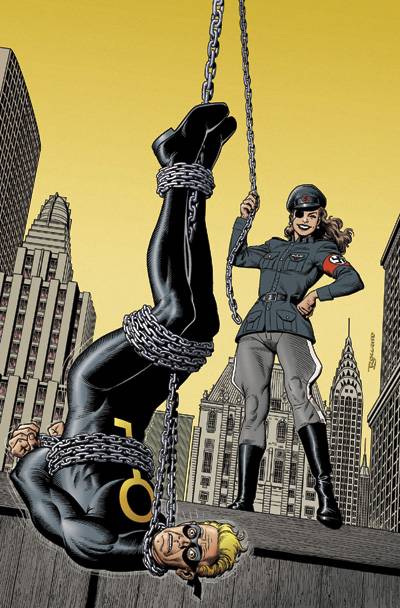
The Escapist can be viewed as Joe's golem for both expressing himself, and trying to move the American public to take action. Throughout the comic, the Escapist fights against Nazi Germany, and on the cover of the first comic book, he is shown punching Hitler in the face. Joe shows in detail through his illustrations the horrors of the conditions the Germany places other countries in through military occupation. He hopes that the images in his comics will be enough to stir the American public to the point of taking action, and that this will allow him to see his family again if the Germans are defeated.
A golem is an animate being created completely from an inanimate material, usually clay. They were created through Jewish folklore, where owning a golem servant was considered a sign of seasoned knowledge, or righteousness. A golem was kept animate by strong magic, and its purpose was to fulfill the demands of its master. They were characterized by their mindless obedience, and can be viewed as a large puppet in the sense that they are only manipulated to serve the purpose of its manipulator.
When first tasked with drawing a superhero for a job application, Joe drew a golem walking down an alleyway. This made clear his thought on illustrated characters, in that they, like golems, had no mind of their own, and only followed the whims of their creator. Joe moves on to write comic about he and Sam Clay's superhero, the Escapist. The hero himself had the abilities of a master escape artist. This mirrored Joe's struggle, as he also was adept in the art of escape, and he was trying to escape from the larger, more abstract concept that he was trapped within the futility of his efforts to affect anything. Joe never truly felt comfortable in New York, and he longed to see his family again, but he knew that this meeting was highly unlikely to ever occur, as his family was caught in the crossfire of the war.
The Escapist can be viewed as Joe's golem for both expressing himself, and trying to move the American public to take action. Throughout the comic, the Escapist fights against Nazi Germany, and on the cover of the first comic book, he is shown punching Hitler in the face. Joe shows in detail through his illustrations the horrors of the conditions the Germany places other countries in through military occupation. He hopes that the images in his comics will be enough to stir the American public to the point of taking action, and that this will allow him to see his family again if the Germans are defeated.
Subscribe to:
Posts (Atom)